

TCFD Compliance
Environment
Society
Corporate Governance
The Group's long-term vision is to realize social and industrial infrastructure that is considerate of the global environment, with our superior motor drive technologies at the core of these efforts.To this end, the Group has made it its mission to sustain social and industrial infrastructure by reliably supplying high-quality and environmentally friendly products and services in Japan and around the world.
Action against climate change is a key management challenge that we must address in order to fulfill our mission. In light of this, we declared our support for the recommendations of the Task Force on Climate-related Financial Disclosures (TCFD) in June 2023.

The TCFD was established in 2015 by the Financial Stability Board (FSB) at the request of the G20 to examine approaches to climate-related disclosure and how financial institutions should take action.It recommends that companies disclose information on governance, strategy, risk management, and metrics and targets regarding climate-related risks and opportunities.
Governance
In order to promote sustainability management across the Group, we established a Sustainability Committee under the Board of Directors and carry out company-wide initiatives based on our Sustainability Policy. The committee, which generally meets once every quarter, is chaired by the President, Representative Director, and its members comprise mainly Operating Officers.
We recognize climate change as a very important challenge and have set numerical targets for the reduction of greenhouse gases. Progress towards these targets is monitored by the committee, and the content of committee discussions is reported to the Board of Directors for incorporation in the Group's management strategy.
Strategies
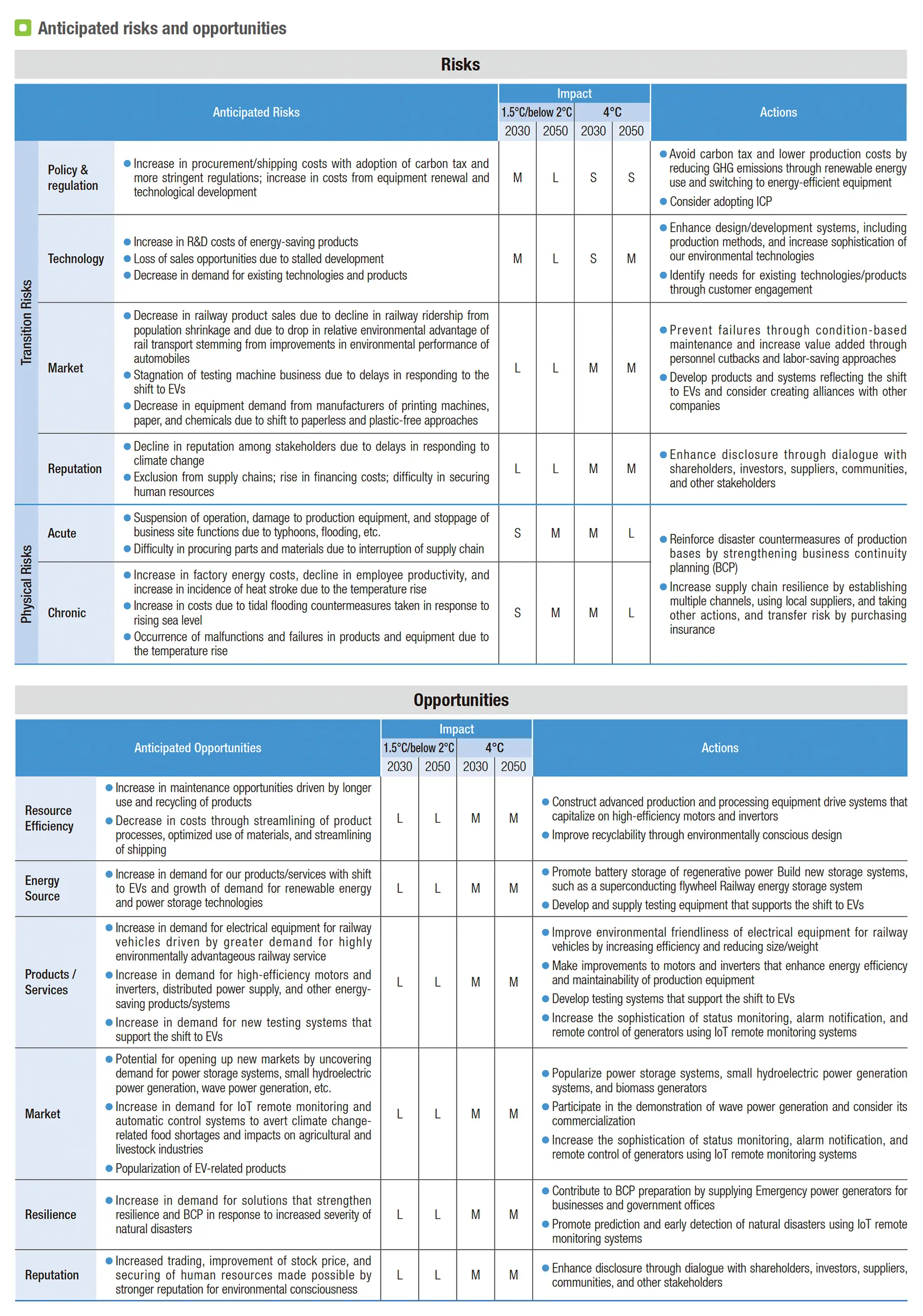
We have analyzed the future impact of climate change on the Group's business activities under the 1.5°C/below 2°C and 4°C scenarios, identifying the associated risks and opportunities and calculating the degree of impact in each case. The focus time horizon was long-term (to 2050) and analysis was also done for the medium-term (to 2030) as a transitional point. The degree of financial impact on business activities was defined according to three levels: large (L), medium (M), and small (S).
| 1.5°C/below 2°C scenario | 4°C scenario | |
|---|---|---|
| Worldview | A lower-carbon transition will take place across society and contain the temperature rise to a certain extent. Demand for energy-saving/eco-friendly products will grow. Legal, market, reputational, and other transition risks will increase. | With priority placed on economic growth, the temperature rise will not be contained and the impacts of climate change will worsen. A lower-carbon transition will not be realized, and physical risks such as extreme weather events will increase. |
| Reference scenarios | SSP1-1.9,SSP1-2.6(IPCC AR6) NZE2050(IEA) |
SSP5-8.5(IPCC AR6) |
Click here for the specific risks and opportunities we anticipate with regard to climate change.
Risk management
A working group made up of working-level employees engages in discussions for advancing a company-wide approach to sustainability challenges. Meanwhile, the Sustainability Committee identifies climate change risks, discusses countermeasures, and monitors progress in implementing those actions. It also tracks the progress of the medium- and long-term sustainability roadmaps formulated by each division.
Indices and targets
We have set the following targets for reducing CO2 emissions associated with our business activities to help curb global warming.
CO2emissions
Scope 1 & 2(compared with FYE May 2018)
- FYE May 2026 targets
- 10% reduction
- FYE May 2030 targets
- 30% reduction
- FYE May 2050 targets
- 100% reduction